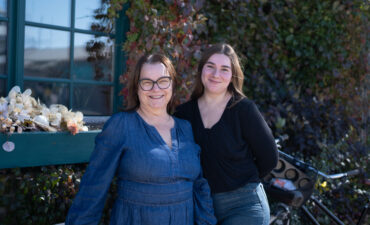
Milena Ehr didn’t leave Venezuela planning to build a life in Canada. Neither did her sister Milly Sywanyk.
Their mother, Milena Araujo, followed and now three generations live in Regina, shaped by two vastly different countries, one they live in and one they have never really left behind.
“There are so many things that tie you to your country, it’s very difficult. Although I’m happy to be here because I’m with my daughters, who are the family I built,” said Araujo. (Araujo’s quotes have been translated to English from Spanish.)
Sywanyk arrived first.
She came to Regina through a program offered by the English as a Second Language (ESL) at the University of Regina in 2002. The program was temporary, and she went back to Caracas after 8 months.
“When I got back home is when things had started to get really difficult in Venezuela politically,” said Sywanyk.
In 2003 she decided to come back and pursue a master’s degree in human resource development. “I had started working in November, and I actually lost my job in December,” said Sywanyk. “All the businesses and industries were completely paralyzed.”
Five years later, her sister Milena Ehr followed.
She came to Regina in 2006 after finishing her degree in sound engineering. Ehr also came through the ESL program to learn English, and like Milly, she did not plan to stay. But life shifted. She built a career and found community in Regina’s Latin people.

Ehr is also a percussionist; she has always held music and her culture very close to her heart.
Back home, Venezuela was not yet the place of mass migration it has become. Their mother, Milena Araujo, remembers that the country once received immigrants.
“After the Second World War, Europeans, Spaniards, Italians, Portuguese migrated to Venezuela,” said Araujo. “We received immigrants. We weren’t a country that emigrated.”
Her daughters’ departures were meant to be academic, not permanent. “I didn’t send them with the idea that they would stay here,” said Araujo. “But life takes many turns.”
Sywanyk and Ehr built their careers, got married and created their families, with children born in Saskatchewan winters far from the Caribbean heat they grew up in.

The early years in Regina were not easy. “I felt very isolated that first year,” said Ehr. “When I got here, I didn’t know English properly, […] but I love talking to people, getting to know things. So it was very hard not to be able to communicate.”
Ehr moved closer to the university so she could walk to class in winter. She built her community slowly, first with other Latin students, then through music, then through teaching Zumba. “It didn’t feel like home for a long time,” said Ehr. “It took me two years to really feel comfortable.”

The meaning of home started to come from the little details: sharing music, arepas made in Regina kitchens, and new friends that feel like family.
“We share our food. In Christmas time, we get together, we make our special food that we make for Christmas,” said Ehr. “Just trying to continue remembering who we really are.”

“Language is definitely one of those smaller things people take by granted. I always feel like I have two identities,” said Sywanyk. “My music and cultural traditions are also super important to me.”
For their mother, migration arrived much later. Milena Araujo raised her daughters alone after being widowed at the age of 36. She encouraged them to study abroad. She did not expect to leave. “As a psychologist, I thought, children aren’t raised to stay with you forever,” said Araujo. “You give them wings to grow.”
For 25 years she travelled back and forth between Venezuela and Canada, spending months at a time with her daughters before returning home. Permanent residency came only in October 2025.

“This adaptation hasn’t been easy for me,” said Araujo. “I long for not having to constantly put on one sweater, then another sweater on top, and gloves and boots.” She misses the tropical weather, the sea and the mountains that frame Caracas.
Araujo also names something she calls familial loneliness. “You don’t have your family close by. In this case, they only have me, their mother, but there’s no one else, no cousin, no uncle, no grandmother.”

Migration in this family was shaped not only by opportunity but also by political uncertainty, and many people who did not leave by choice.
“You have to live through those experiences to know how life is in each country,” said Araujo. “How can you explain? We’re in an oil-producing country, and we have to stand in line for 5, 6 hours to fill up our cars with 120 L of gas per month.”
With the recent capture of President Nicolás Maduro, orchestrated by the US government and President Donald Trump, Ehr rejects narratives that ignore the voices within the country and stresses the need for solutions for the Venezuelan people, who don’t seem to see any difference. “I have people all over that were affected by what just happened. Just living in that fear, and that fear has not gone away, no matter what.”
The University of Regina’s ESL program became one of this family’s first footholds in a new country. “The programs not only help with language skills and confidence but also the skills required to integrate into postsecondary institutions,” said Karlie Butler, head of the English language programs.
For the sisters, language was the first barrier. For their mother, the struggle came with age.
“After you’re 60 or older, how can you adapt to a country that you think will be your home? You’re going to die in a country that wasn’t yours,” said Araujo. “It’s not easy.”

Yet, bringing her to Canada became urgent. For eight years, the sisters applied to bring their mother permanently to Canada. When her residency was approved, relief followed.
“My mom is now living here, which also makes a big difference,” said Millie. “Having my mom in Canada ensures that I know that she’s safe.”