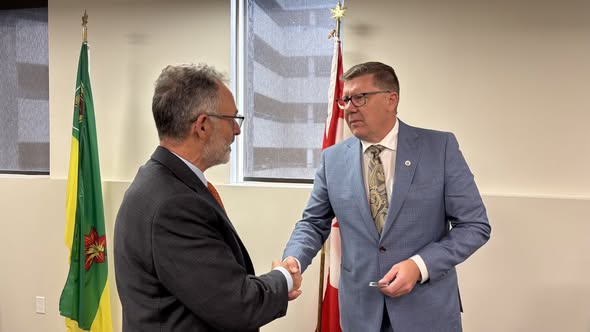
Pro-Palestine activist Tiro Mthembu claims Iddo Moed’s recent visit to Saskatchewan continues a long genocidal history in the Prairies.
“We should all be appalled that our government would shake hands with a government committing genocide…”

Moed, Israel’s ambassador to Canada, visited Saskatchewan a month after the United Nations declared Israel had committed genocide in Gaza, accusing the Israeli government of war crimes like blocking humanitarian aid and directly targeting children.
Mthembu, community organizer in The Heritage Community in Regina, protested the meeting between Moed and Premier Scott Moe in a recent pro-Palestine rally.
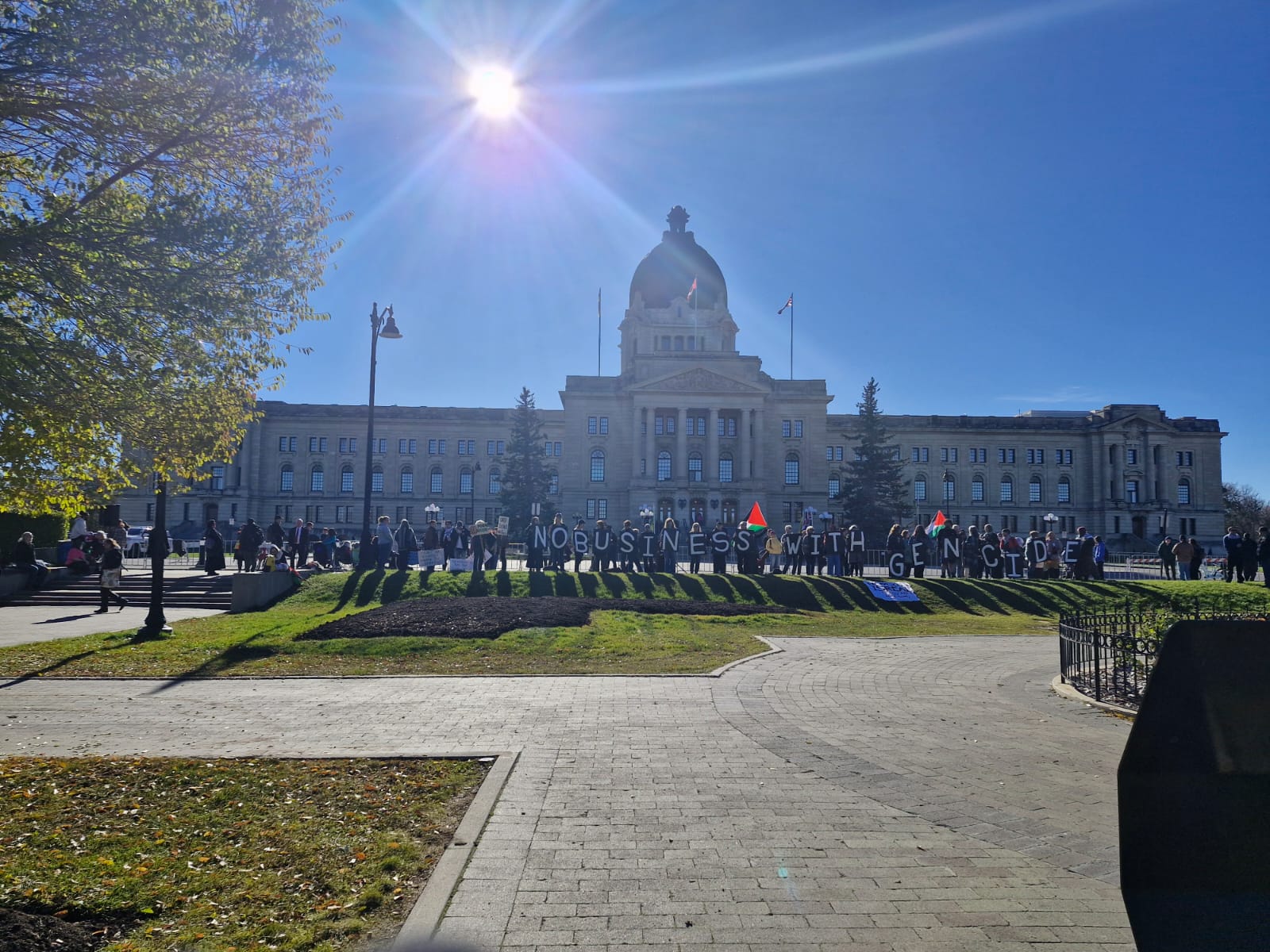
Mthembu believes there are similarities between the recent Israeli visit and the visit Glenn Babb, South African ambassador, paid to Manitoba during 1987 before the end of apartheid. The South African and Israeli governments have been accused of violating human rights.
In a Facebook post, Premier Moe stated that the meeting is meant to “expand technological cooperation and market diversification.”
The premier’s office did not respond to questions relating to Mthembu’s claims.
Mthembu wants to know why Scott Moe decided to talk trade with a government accused of genocide, and how trade with Israel can be seen as disrespectful for a provincial government that is “trying to live in real truth and reconciliation.”
Mthembu’s parents were part of the anti-apartheid movement at the University of Saskatchewan during the 1980s. His father was a political refugee from South Africa and his mother was a Canadian protester who was “beaten by the police” at one of the movement’s protests.
Mthembu said that the reason why Glenn Babb’s visit was made specifically in the Prairies is “directly linked to our colonial roots.”
“Saskatchewan [stood] with Edgar Dewdney,” said Mthembu, referring to the lieutenant-governor (1881-1888) and Indian commissioner (1879-1888) for the North-West Territories.
Dewdney mandated policies that were “successful in dismantling and oppressing Indigenous populations,” which is what Mthembu said Glenn Babb came to research.
Mthembu said that there is resemblance between the Indian Act and the laws that South Africa placed during apartheid. He compared reserves to townships and identity cards with treaty cards.
Edgar Dewdney did not create the Indian Act. According to the Parks Canada website, the lieutenant enforced it through coercing First Nations into entering treaties and settling on government-selected reserves.
“Now we can see that directly in the Israeli occupation in Gaza,” said Mthembu.
Comparisons between apartheid (which means “apartness” in Afrikaans) and the Israel-Palestine conflict have been made historically by pro-Palestine activists.
Julie Peetet, professor at the University of Louisville, wrote a journal article about the comparisons. She wrote that similarities have “emerged with vigour” since the mid-1990s.
“Hierarchical social order rested in South Africa and is today operative in Israel/Palestine,” wrote Peetet. The centerpiece of comparison are practices like dispossession, exploitation and confinement.
Alice Walker, American novelist and activist, wrote a poem in 2009 about her visit to Gaza. “Rolling into Gaza I had a feeling of homecoming. There is a flavor…To the Bantustan. To the ‘rez’”” wrote Walker, comparing Gaza to Bantustan (a territory the South African government designated for black inhabitants) and to Indigenous reservations designated by governments like Edgar Dewdney’s.
“Sanctions, sanctions, sanctions,” said Mthembu. He argued that sanctions and boycotts worked once to protest apartheid in South Africa and Canadians should demand it now amidst conflict.
Although apartheid started in 1948, Canada did not put sanctions into place until 1985. Apartheid came to an end nine years later.