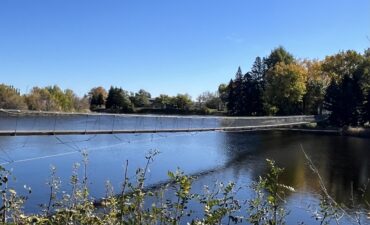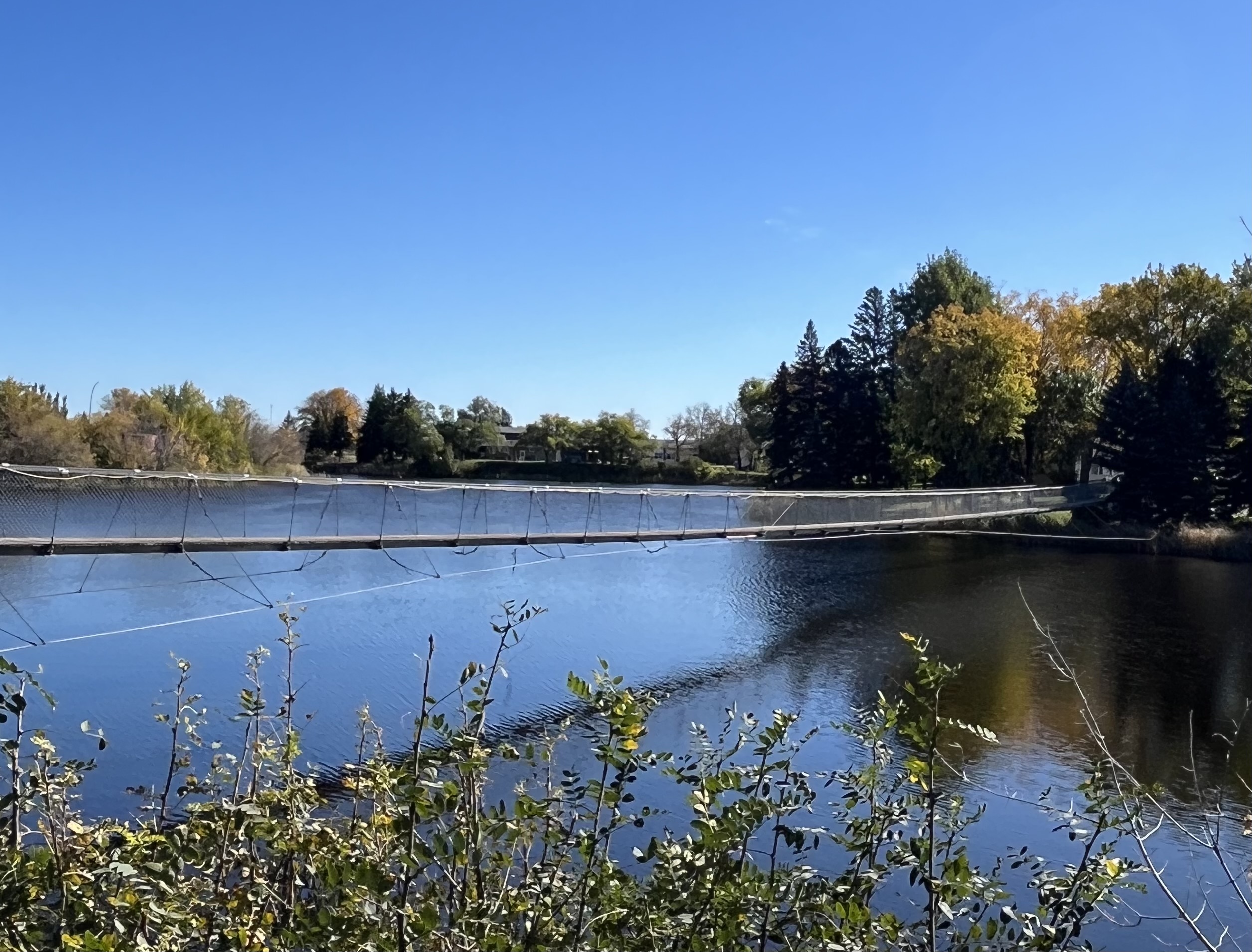
Located in Southern Saskatchewan, Wolseley is a close-knit community of 852 residents and home to the Swinging Bridge, an attraction that brings tourists from near and far.
Used by numerous tourists and locals on a daily basis as a walking path or shortcut across town, Wolseley’s Swinging Bridge attracts 200 people on an average summer day.
“I think people like seeing old towns and what they have to offer,” said Wolseley local Candace Thompson. “Even though we have lots of other older buildings and things, lots of people come from out of town to ask about the bridge and cross it.”
The 100-metre bridge is not the first of its kind, with the first Wolseley bridge being constructed in 1892 to accommodate locals’ routes downtown. Although the first bridge was built as a standing footbridge, built on stilts, the following three models were built as what is known today as the swinging bridges.
Stephen Scriver, the town archivist, emphasizes Wolseley’s tourism identity, with it being titled ‘the town with the swinging bridge’ by nonresidents.
“It’s very scenic over there,” said Scriver. “I have a postcard that I found on eBay, and the guys who took that picture stopped in Wolseley and went over the Swinging Bridge.”
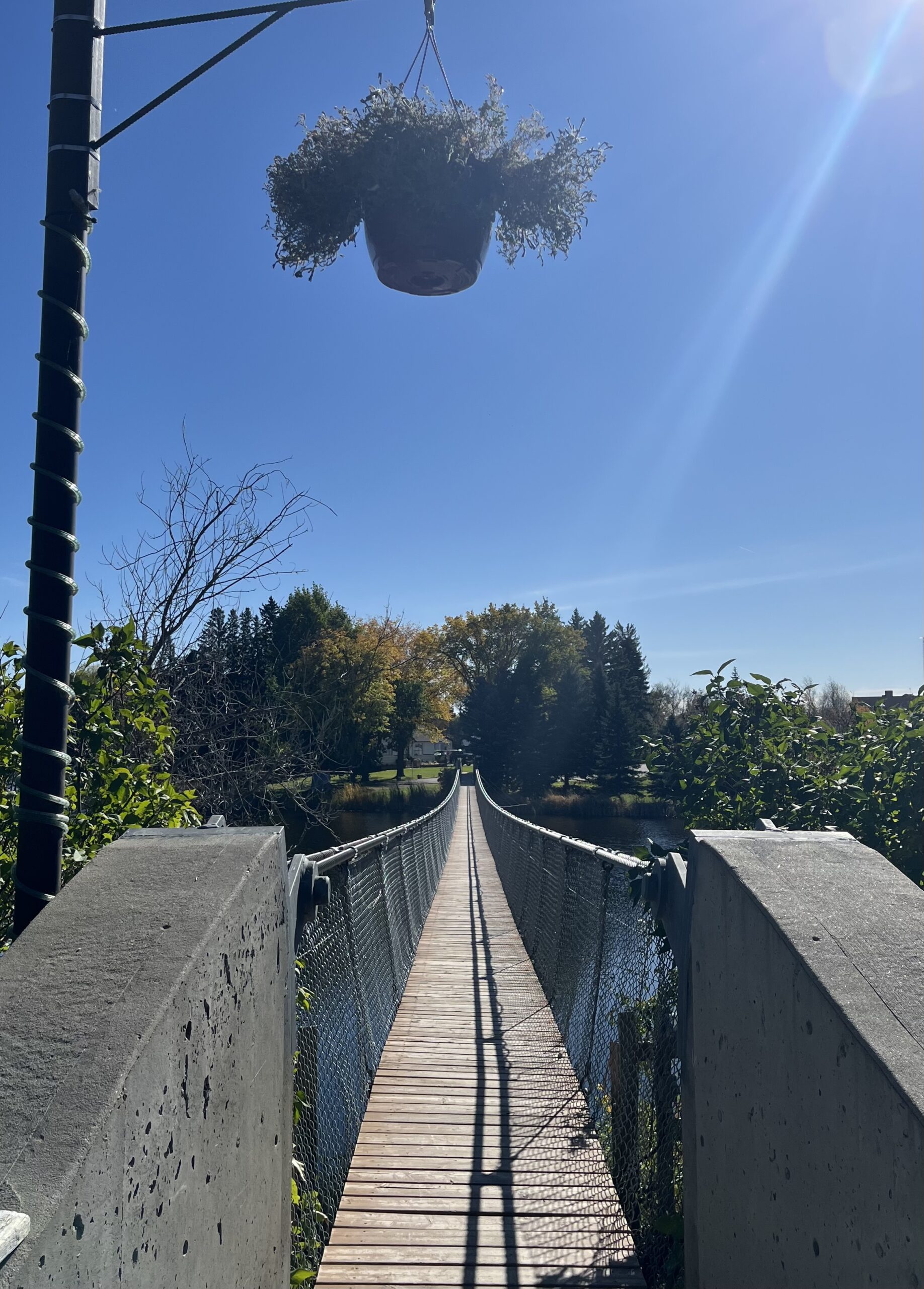
But the famous Swinging Bridge is not only used as a tourist attraction for the rural town– it is also a place of history that helps define Wolseley’s community today.
With the goal of informing the public of that history, near one of the bridge’s entrances stands a plaque that reads the history of the bridge. However, Scriver explains that the information displayed on it is false, and tells the true evolution of the bridge from the first model to today’s swinging bridge.
Over the past century, Wolseley’s bridge has been rebuilt multiple times. Scriver explains that after its creation as a footbridge in 1892, the bridge was rebuilt in 1907 as the first swinging bridge by a Manitoban contractor.
“During the winter of that year, some children were on this bridge when an awful wind came up and threw them off and damaged the bridge,” said Scriver. “The town did sue this guy, and one of Wolseley’s local farmers at the time fixed it.”
The repaired bridge lasted until 1954 when a plough wind destroyed the bridge. Wolseley was left without a swinging bridge until 1964, when another local farmer rebuilt the bridge, and finally again in 1993 before the current-standing swinging bridge was constructed in 2004.
“[The bridge] is part of our town’s character,” said Scriver. “Who else has a 100-metre swinging bridge? If it got blown down tomorrow, there’d be a committee struck, and we would find a way to rebuild it.”
Because the Swinging Bridge is such a crucial aspect of Wolseley’s identity and history, each bridge is funded by the townspeople. Thompson says she knows numerous other locals that use the bridge to make traveling across town more efficient, the same reason why the bridge was built in the first place.
“There are always going to be people that think it’s important to have the bridge, mainly locals,” said Thompson. “It’s efficient and it really is a staple of our town.”
The effect of the bridge’s success in attracting tourists to Wolseley has made it a desirable place to retire. The open and scenic view of the bridge over the lake, surrounded by large trees, paints a calm and perfect picture.
Whether you’re standing on the side of the lake, or directly on the bridge, both locals and tourists can see the natural beauty in all seasons of Wolseley, Saskatchewan.